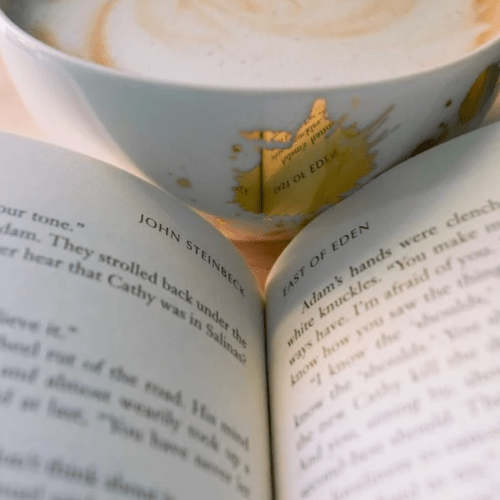
Everyone has their own idea of what makes a good story.
The idea itself is purposefully subjective, shaped by our own individual selves and how we interpret the world around us. The intention is for the reader to develop their own relationship with a work and decide for themselves what they think.
The idea of “good” storytelling has been circling my mind for the last few months as I work on the first draft of my novel. Like any firsts, I am timid and wildly insecure about the effort on the page, questioning everything as I go.
Through all of this, I’ve quickly come to discover how hard it is to write a book – to write anything meaningful, really – pulling what you from your mind and articulating it clearly onto the page. I’m learning that a writer never knows what they have until they put it onto the page, the text revealing itself to you when it has decided it’s finished. Write first, agonize later.
I’m crazy to think that what I have, the mere zero draft, is the epitome of any quality I can produce. The text hasn’t even shaped itself yet. What an amateur move to think I have any control here when the text has a mind of its own!
When in these moments of doubt, I turn to my literary teachers for guidance, one of my favorites being Toni Morrison. In her essay “Invisible Ink: Reading the Writing and Writing the Reading” from her book of essays The Source of Self-Regard, she introduces us to “invisible ink”.
“Invisible ink is what lies under, between, outside the lines, hidden until the right reader discovers it…the reader who is ‘made for’ the book is the one attuned to the invisible ink.”
As the reader explores the text, they witness how it shifts and reshapes in front of them, changing from a solitary form to something fully alive, taking on a life of its own. The most effective invisible ink feels like an awakening, an intense realization, as they come to discover that what they thought they knew about a text is completely different from what is now presented.
True invisible ink is a showcase of an author’s power to transport a reader into a new story, starting at one level and then slowly graduating to another the more layers that are pulled back, deepening the experience the more layers are pulled back until a new story has bloomed.
The closer a text is read, the more the reader uncovers and starts to question the choices an author is making that make an impact on the story. In this inquiry, nothing is left off the table:
What if Shakespeare had chosen another man to embody the spirit of Othello instead of a Moor?
Would Ann Petry’s Lutie Johnson had been considered differently as a mother if she had made different choices in The Street?
Would Bram Stoker’s Dracula been any less terrifying if he set the backdrop of the count’s birthplace in another country instead of the mysterious Transylvania?
Each choice the author makes is scrutinized, offering a variety of avenues that can be interpreted in order to fill the gaps left by the author. The gaps, while frustrating for some, are the invitation, encouraging further study and unlocking a doorway to revealing a new story entirely as they uncover new meaning.
When the reader picks up a book, they sign a contract with the writer, an agreement that indicates their intention to engage with the work fully, jumping into gaps and figuring out for themselves how to fill them.
Reading this deeply was almost a requirement for Toni Morrison. She wasn’t dismissive of readers who stayed at the surface of her work but, rather, encouraged them to explore, play, and have fun.
“Writing the reading involves seduction – luring the reader into environments outside the pages. Disqualifying the notion of a stable text for one that is dependent on an active and activated reader who is writing the reading – in invisible ink.”
When you invested time in her work, you agreed to participate in how the text unfolded, inserting your own thoughts and feelings, allowing the text to evolve as you do. She was aware not all of her work was intended for every reader. Yet, she still left the invitation on the table in the event the “right” reader was up for the chance of being surprised.
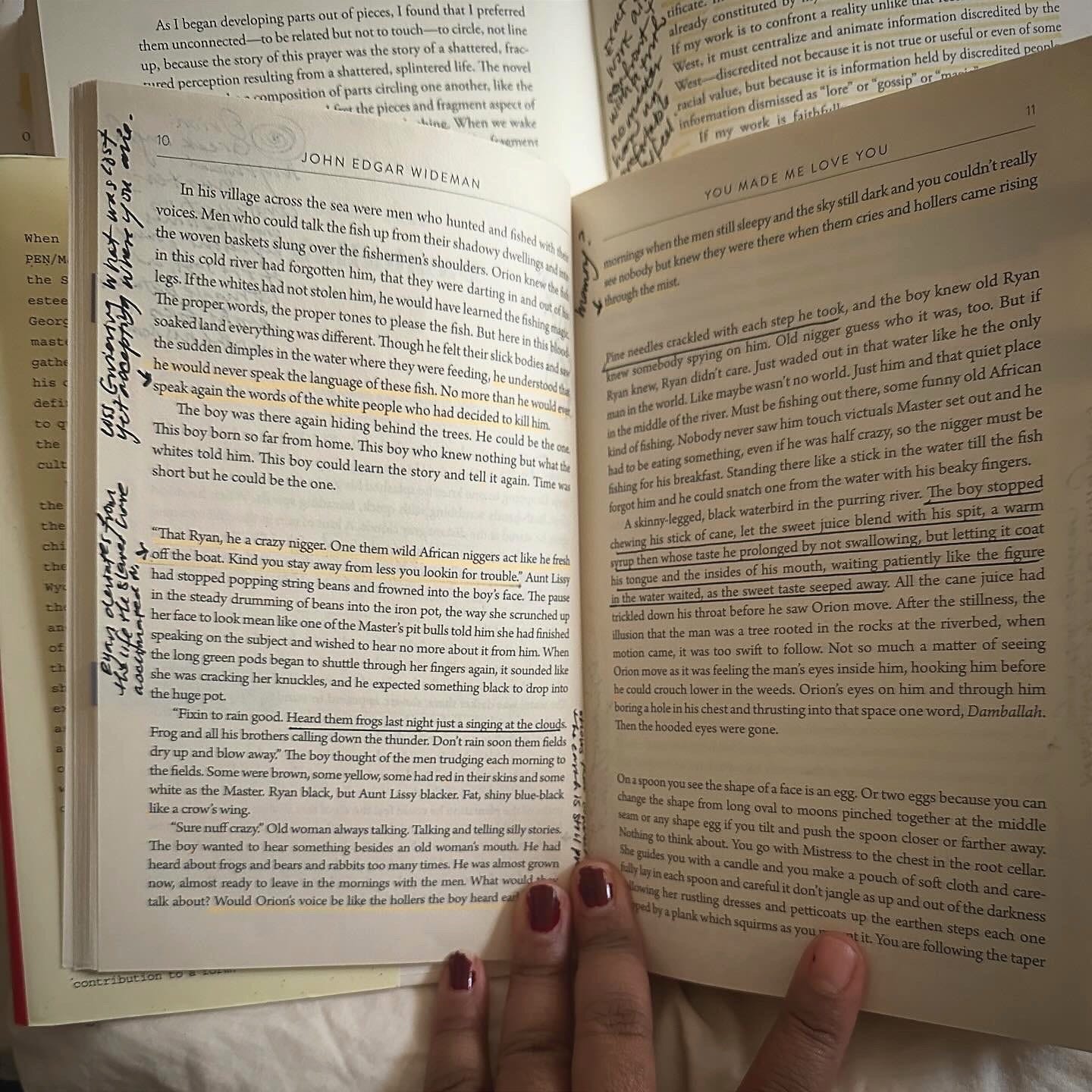
For me, there is no better way to experience a work of literature, indulging in the thrill of sitting with a text, dissecting each line, the language, a reference an author throws out, and the reward you feel you’ve achieved when you unlock something that wasn’t there before. There is magic to be discovered when you are in conversation with the author if you’re willing to initiate it.
The idea of creating a work engaging enough for the reader is daunting. I’m questioning everything, wanting to ensure each element of the story brings with it a purpose in giving the reader a memorable experience. I am understanding more how these choices help develop empathy within the reader, building the story from the ground up, bringing it all to life. But how to incorporate this magic into my own work? And how will I know when this has been achieved?
It took Ralph Ellison five years to carefully craft what would be his masterpiece Invisible Man. In his interview with The Paris Review, he spoke at length about studying the masters – Dostoyevsky, Dickens, Hemingway, among others – using their style as inspiration as he constructed his own work. He was meticulous in his own study, mindfully observing their form, and adding his own rhythm that gave the novel its visceral essence as you follow the narrator of the story on his journey.
Even after all the praise and winning the National Book Award in 1953, he still wasn’t convinced he had achieved what he set out to.
I find myself taking a similar path, revisiting some of the classic works, exploring new ones to see if I am able to detect the invisible ink used to learn its application to help inspire my own rhythm and style. I am reminded by Morrison’s words to not forget the other half of this intimate relationship – the reader – reminding me that my work will be discovered when they’re ready to find it.
So, the writing continues, the meaning will be found as the language is constructed, and I must trust that when the right reader finds me, the real magic will reveal itself.

 Sips + Quill
Leave a comment